Showing posts with label Ballpoint pen. Show all posts

Saturday, January 29, 2011

A Brief History of Early Fine Ink Pens

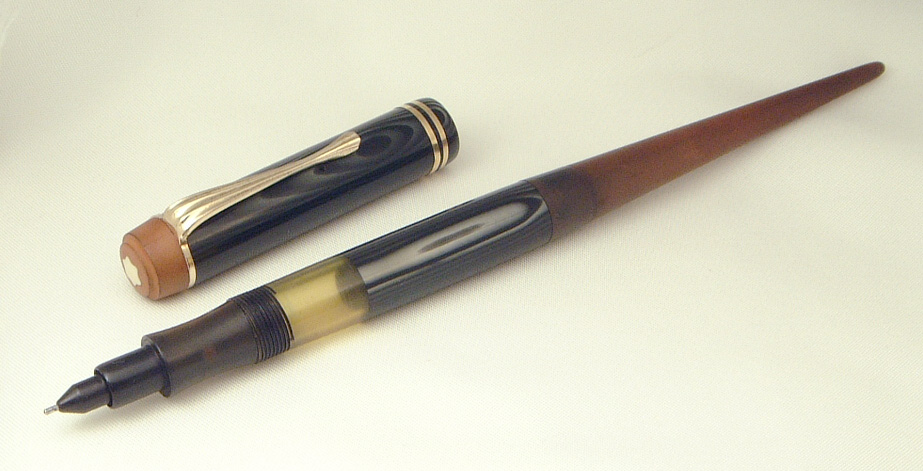
fountain pen.JPGImage by Bright Meadow via Flickr
If you have ever sat down to write an old fashioned letter, address formal envelopes or write a speech, you probably have an appreciation of the artistic qualities of fine pens. Fine writing pens offer an authentic, nostalgic communication experience that typing or emailing simply cannot. It has been said that when people express their thoughts with fine ink pens as opposed to other forms of writing, they invoke a more emotional response from their reader. This is because unlike fine pens, online and typed messages lack the essence of the writer's personality.

The first fine pens were made with mass produced pen points that were stamped out of sheet metal and molded into various shapes to suit different styles of writing. To use, writers selected a pen point, fitted it onto a holder, dipped the tip in ink and began writing. Although innovations to the design of the instrument began in the latter part of the 19th century, this remained a popular format for fine writing pens until as late as the 1950s.

In an effort to eliminate the need to carry around an ink well and continuously dip the pen point, a portable fine pen that could carry its own refillable ink supply became necessary. Thus the fountain pen was born. A fine pen that featured a three channel feed was developed in the 1870s by L.E. Waterman. This design allowed for a smooth, controlled flow of ink via a pumping action, wherein the pen point snapped back and forth from an interior ink sac.

The next generation of fine pens used what is known as the self-filling system. They were also referred to as "eyedropper" pens because in order to fill them, users had to unscrew them and pour the ink supply in through a long dropper. Unfortunately, the fit between the cap and the barrel was not always secure and leaking was a common side effect. Therefore a model was invented in which the point was retracted into the barrel with a twisting motion, similar to a tube of lipstick. Theses were called safety pens.

Other variations on self-filling fine pens debuted throughout the years, including the blow filler, the sleeve filler, the button filler, the level filler, the pneumatic filler, the piston filler and the plunger filler. These represented the standard in fine writing pens until the invention of the cartridge pen in the 1930s, which is similar to the pens that are most commonly used today. They contained a glass ink cartridge (now made of plastic) that was intended to be disposable rather than refillable.

Early fine pens offer a glimpse into our communication history and as such have become a popular collectors' hobby. If you interested in learning more about fine pens, online retailers can offer a wealth of knowledge as well as unique items to start your collection.

Wayne Hemrick writes about - fine pens.

Article Source: http://EzineArticles.com/?expert=Wayne_Hemrick
Enhanced by Zemanta

Vintage Fountain Pens - Getting Started in the Hobby of Collecting

The Golden age of the fountain pen is usually considered to have started in the late 1800s, when it became the writing instrument that dominated, through World War II when it was largely replaced by the ballpoint pen.

During this roughly 60 year period there were an extraordinary number of innovations and styles introduced by many different manufacturers. Many of the pens created during this time are prized by collectors for their beauty and functionality.

Although fountain pens are still manufactured today and are still in demand as writing instruments, collectible vintage pens are generally considered to be those made before 1965. There are an extraordinary variety, and vintage pen collecting is a hobby that many people enjoy.

It's easy to get started. They are vintage pen shows held throughout the United States, mostly near larger cities. By visiting one of these pen shows you will have the opportunity to talk to knowledgeable collectors and viewed thousands of vintage pens.

You could also just go on eBay and randomly start buying pens that appeal to you. Just like with used cars, however, different pens have varying values depending on the model, manufacturer, and condition. While you would rapidly build up a pen collection this way, some knowledge about what you're buying is essential.

Fortunately there are some pen guides available which you can use to educate yourself and help make a wise decision when buying a vintage pen. If you are serious about collecting antique pens as a hobby, you will want to add a few good reference books to your personal library.

One of the best books recommended for beginning collectors is Fountain Pens Past & Present -- Identification & Value Guide by Paul Erano.

This is considered by many vintage pen collectors to be a very comprehensive book about how to collect vintage pens. There are many color photos and also vintage fountain pen ads. It has lots of different and valuable information, talks about how to find vintage pens and restore them. It also covers the basics for how to value pens. Of course the actual values for specific pens change over time. However this book is a good guide to determining the relative value of different vintage pens. If you are truly interested in collecting antique pens as a hobby, this is an excellent book to add to your collection.

Also, thanks to the Internet, you can frequently locate copies of the actual brochures published by a pen manufacturer for those vintage pens you are interested in. The original brochures are collectibles by themselves, but you can also frequently buy a PDF version in an electronic format to uncover as much detail as possible about your pen.

eBay is an excellent place to find fountain pens. At any one time there usually are over 1000 auctions going on for vintage pens. In general, when competing in an eBay auction, keep in mind that there are other people who want the same pen that you do. They may be willing or to pay more than the pen is worth so to avoid this you should always do your research, determine the approximate value for the pen, set your personal limit as to the amount you are willing to pay, and stick to that.

Because there are such a huge number of auctions on eBay, if you are unable to buy one particular vintage pen because you are outbid, the chances are good that there will the another pen similar to it auctioned in the near future.

Sara Bondia writes on a wide variety of topics and regularly contributes articles to different websites. For information on how to find an extraordinary variety of collectible vintage fountain pens visit [http://www.vintage-fountain-pens.info]

NOTE: You have full permission to reprint this article within your website or newsletter as long as you leave the article fully intact and include the author's information and the website link.

Enhanced by Zemanta