Showing posts with label Collecting. Show all posts

Sunday, April 3, 2011

Fountain Pen Hospital

vintage Pens
  (Page 1 of 5)  View Page: 1 | 2 | 3 | 4 | 5 | Show All     The Back Room

  Last Updated 4/1/2011 4:26 PM   (*Recently Updated)


Aurora #98 Fountain Pen & Pencil Set - Gold-filled Caps - Piston Fill  -Small Ding In Fountain Pen Cap - Pencil Missing Tiny Piece At Tip So Lead Does Not Retract Entirely
See item above
Aurora #98 Fountain Pen & Pencil Set - Gold-filled Caps - Piston Fill -Small Ding In Fountain Pen Cap - Pencil Missing Tiny Piece At Tip So Lead Does Not Retract Entirely 
Year: 1975
Type: Fine Nib - 5 1/2 In. Closed - Excellent
Price: $195.00

Conklin Jr. Endura - Mahogany Hard Rubber - Gold Filled Trim - Lever Fill - Light Wear To Barrel Imprint
See item above
Conklin Jr. Endura - Mahogany Hard Rubber - Gold Filled Trim - Lever Fill - Light Wear To Barrel Imprint 
Year: 1933
Type: Fine Semi-Flexible Nib - 5 In. Closed - Excellent
Price: $195.00

Conklin Endura Symetrik - Standard Size - Green Marble - Gold Filled Trim - Lever Fill
See item above
Conklin Endura Symetrik - Standard Size - Green Marble - Gold Filled Trim - Lever Fill 
Year: 1935
Type: Firm Fine Nib - 5 1/4 In. Closed - Near Mint
Price: $250.00

Conklin Green/Black Speckles - Gold Filled Trim - Lever Fill
See item above
Conklin Green/Black Speckles - Gold Filled Trim - Lever Fill 
Year: 1928
Type: Medium Flexible Nib - 4 7/8 In. Closed - Near Mint
Price: $295.00

Conklin Jr. Endura - Lapis Blue - Gold Filled Trim - Lever Fill
See item above
Conklin Jr. Endura - Lapis Blue - Gold Filled Trim - Lever Fill 
Year: 1932
Type: Firm Fine Nib - 5 In. Closed - Near Mint
Price: $275.00

Conklin Jr. Endura Set - Black/Bronze Marble - Gold Filled Trim - Lever Fill
See item above
Conklin Jr. Endura Set - Black/Bronze Marble - Gold Filled Trim - Lever Fill 
Year: 1932
Type: Some Small Chew Marks On Cap - Fine Rigid Nib - 4 3/4 In. Closed - Price For Set - Excellent
Price: $265.00

Moore Maniflex - Brown Snakeskin Celluloid - Gold Filled Trim - Lever Fill - Some Brassing On Cap Band
See item above
*Moore Maniflex - Brown Snakeskin Celluloid - Gold Filled Trim - Lever Fill - Some Brassing On Cap Band 
Year: 1938
Type: Extra Fine Nib - 5 In. Closed - Excellent
Price: $195.00

Parker Jr. Duofold  Streamline Set  - Lapis Blue - Button Fill - Gold Filled Trim
See item above
Parker Jr. Duofold Streamline Set - Lapis Blue - Button Fill - Gold Filled Trim 
Year: 1929
Type: Firm Fine Nib - 4 1/2 In. Closed - Price For Set - Excellent
Price: $365.00

Enhanced by Zemanta

Saturday, February 5, 2011

On First Edition Books

Cover of book and dust jacket from German edit...Image via Wikipedia
Though today is definitely the computer age, there are still some “old fashioned” ways to gain information and entertainment. Books are an institution—one that will not be falling to the wayside anytime soon. If you love books, you can do more than just read them—you can make a hobby out of collecting them.

Books are printed in three primary formats: hard back, paper back and trade copy. Hardback books are generally more expensive than the others, often because of the cost of binding. Paperbacks cost usually a third of what the hardback version costs. Trade copies are an animal unto themselves. Trade copies are paperbacks that are distributed to people in the writing world, generally before the actual book is published. Paperbacks are fine, if you just want to read the book. Hard back and trade copybooks are where the game begins, and if you are incredibly lucky, where the money is. This is where we will focus our attention, for purposes of this article.

There is a certain cache to having a first edition of a prized writing. The first edition of a book, in general, is printed and bound in hard back, with a book jacket covered with art (often from a notable artist). Having said that, however, there are times when first editions, particularly of new writers, are printed in paperback, so this is not a hard and fast rule. But, generally, hard backed books are the primary targets of collectors.

Why, you ask, does this matter? To collectors, this means everything! People sometimes pay exorbitant amounts of money for a first edition hard back of a book they love, or for a book penned by an author they love. People fill bookcases in their homes and offices with these beloved writings. Collecting books, like so many other things, is a game of acquisition. The good news about collecting these often expensive writings is you can actually use them for their intended purpose! They do not need to sit on the shelf merely collecting dust.

There are many sources that are useful in locating these little gems. Depending on what genre you are interested in collecting, you can start as easily as picking up a favorite author’s latest book at your local bookstore. Other places to look for books for your collection are: yard sales, book shows, used bookstores, and online sites that sell books.

How do you know if your book is a first edition?

This gets a bit complicated. Different publishers use different markings to identify what edition a book is. What you need to do is open the book to the front few pages, where the information about the publisher is located. Look for a set of numbers, i.e., 1 2 3 4 5 6 7 8 9 0. Either above or below these numbers might be the words “First Edition” all by itself or with a month and year. If this is a new book, all you really need to do is verify higher on the same page that the first printing was in the same month and year, and with that combo you are in pretty good shape. On older books, you can do the same comparison, or you can look at the numbers. Some publishers have the 1 listed first and that means it’s the first printing. Others have a zero in front, and that means it’s the first printing. It is important to do a little research into the practices of the publisher your author(s) of choice use, as this will help a great deal in finding true first editions. The research aspect is part of what makes collecting fun. Once you have a good grasp on what certain publishing companies do to mark their books, you can start looking for treasures in unlikely places—garage and estate sales, auctions, used book stores that do not specialize in hard-to-find books and discount book sellers.

So, you have decided you wish to collect all of the works of your favorite author. You have studied up a little on the publishing company he/she generally goes through, and you are armed and ready to start building your collection.

Some things to look for in a good purchase:

The real estate market has their own mantra: “location, location, location!” Book collectors have their own mantra: “condition, condition, condition!” Once you have identified a book that you want, there are a few things to check before purchase, as these items can considerably affect the value of that book you are holding.

First of all, check the book jacket. Some booksellers will encase the book jacket in a Brodart or similar product that protects the jacket from dust and tears. The book jacket should be complete, untorn, and unwrinkled. Make sure the jacket belongs with the book; just compare the titles. Sometimes, jackets will be changed in later printings, and that new jacket could end up on your first edition book—where it does not belong. Just do your research in advance, and you will learn to detect these things.

Secondly, and more importantly, check the binding of the book and the condition of the content. The binding should be tight—meaning none of the pages should be loose or coming free from the binding. The pages should be unbent and uncreased (this is why some people get so upset over people folding over a page to hold their place in a book—those creases never truly go away), and none of the pages should be written on. This last item makes collecting children’s books a challenge because so many kids doodle in their books.

Finally, check the book for signatures. It is entirely possible to obtain a first edition of a book that has been signed by the author. The more valuable signatures are the ones that are generic; meaning they are not “to” anyone. Those resell better, because someone named Bob does not necessarily want to proudly display a note in their book from the author that says “Best of luck, Jim!” This brings me to another thing. Book signings, while somewhat less common than they used to be, are still there. Often, you can take your books to a book signing and the author will sign a certain number of them for you! This instantly raises the value of your book, and isn’t a bad idea if you are a serious collector.

The value of these books is what the market will bear, and can increase and decrease drastically for any number of reasons. A small percentage of people actually make money off collecting books, but the majority of collectors are in it for the thrill of the chase, and pride of ownership. Just decide where you want to be on the collecting ladder.
Enhanced by Zemanta

Sunday, January 30, 2011

The Typewriter: 7 Tips for Collecting Vintage Writing Machines

Underwood TypewriterImage via Wikipedia
The familiar sounds of pecking away at the keys of your manual typewriter are indigenous to the way typing used to be. Waiting on the infamous sound of that "ding," you knew the end of your right margin was near. As you move the silver lever and coax a carriage return, your new line appears to begin typing once again.
Two basic categories that all writing machines can be placed in is either "keyboard" or "index." The keyboard category is when a keyboard is used to select the character you want and the key is depressed to print the character. An index typewriter has a chart on which all the characters appear using a pointer or wheel to select the desired character. Manipulation using another lever or mechanism prints the character.


It takes time and patience to extensively research and learn about collecting typewriters. There are hundreds of typewriter brands and thousands of models. Here are seven things to contemplate when searching to begin collecting vintage typewriters:

1. Rarity: Consider the make, model, year, use of materials and any other unique facets that create a rare vintage collectible.
2. Condition: Most vintage pieces will probably need some type of restoration. Investigate your potential collectible to estimate the amount of repair work needed and filter in estimated costs that would get it back in satisfactory working condition.
3. Type of mechanism: The operational makeup of the typewriter.
4. Exquisiteness of the design: The beauty of the typewriter. This includes style and other decorative elements like bronze and floral accents or mother of pearl inlays.
5. Personal affection of the piece: What draws you to a particular vintage model that makes you desire to buy it.
6. Join a collectors association: Search to see if there are any local clubs or organizations in your area. You may find that typewriter manufacturing companies could give you some leads on your inquiry.
7. Contact other collectors: You can check out some online collector's websites for information on buying or selling vintage typewriters.

There are relatively few collectors, so you will find that the prices on early typewriters are not fixed. Vintage typewriters may turn up at antique shows, flea markets, attics, garage sales, thrift stores or dilapidated shops carrying second-hand goods. It's a rarity that you will find vintage typewriters in elegant antique shops.

Early typewriters focused on visible distinctions and principal mechanics. Improvements were made in basic design elements, such as the system of linkages from the key to the type. Features maintained "type" alignment. Of course newer designs operated on fewer parts than earlier writing machines. These features made typing faster and easier. Amazingly, typewriters became quieter and more reliable. As typewriters evolved, inventors and manufacturers continued to develop the ultimate writing machine. Although vintage typewriters are not a popular collector's item, they are beginning to gain global attention from writing and engineering enthusiasts, historians and many people interested in collecting rare pieces of writing machine history.

Kym Gordon Moore is a member of the North Carolina Writer’s Network with over twenty six years of corporate and personal writing experience. As a public relations strategist for budget conscious new authors, she coordinates creative marketing packages for her clients. Many of her articles, essays, short stories and poems appeared in a variety of magazines, newspapers, ezines and anthologies. http://www.kymgmoore.com


Enhanced by Zemanta

Saturday, January 29, 2011

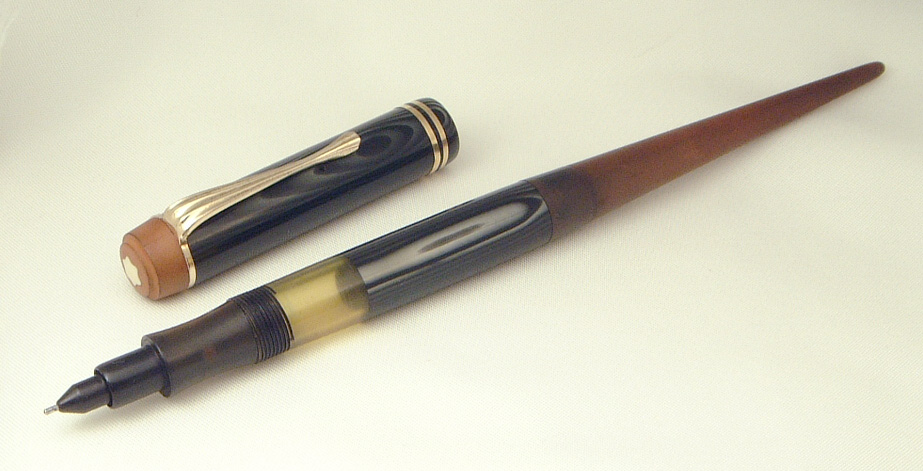
Vintage Fountain Pens - Getting Started in the Hobby of Collecting

The Golden age of the fountain pen is usually considered to have started in the late 1800s, when it became the writing instrument that dominated, through World War II when it was largely replaced by the ballpoint pen.

During this roughly 60 year period there were an extraordinary number of innovations and styles introduced by many different manufacturers. Many of the pens created during this time are prized by collectors for their beauty and functionality.

Although fountain pens are still manufactured today and are still in demand as writing instruments, collectible vintage pens are generally considered to be those made before 1965. There are an extraordinary variety, and vintage pen collecting is a hobby that many people enjoy.

It's easy to get started. They are vintage pen shows held throughout the United States, mostly near larger cities. By visiting one of these pen shows you will have the opportunity to talk to knowledgeable collectors and viewed thousands of vintage pens.

You could also just go on eBay and randomly start buying pens that appeal to you. Just like with used cars, however, different pens have varying values depending on the model, manufacturer, and condition. While you would rapidly build up a pen collection this way, some knowledge about what you're buying is essential.

Fortunately there are some pen guides available which you can use to educate yourself and help make a wise decision when buying a vintage pen. If you are serious about collecting antique pens as a hobby, you will want to add a few good reference books to your personal library.

One of the best books recommended for beginning collectors is Fountain Pens Past & Present -- Identification & Value Guide by Paul Erano.

This is considered by many vintage pen collectors to be a very comprehensive book about how to collect vintage pens. There are many color photos and also vintage fountain pen ads. It has lots of different and valuable information, talks about how to find vintage pens and restore them. It also covers the basics for how to value pens. Of course the actual values for specific pens change over time. However this book is a good guide to determining the relative value of different vintage pens. If you are truly interested in collecting antique pens as a hobby, this is an excellent book to add to your collection.

Also, thanks to the Internet, you can frequently locate copies of the actual brochures published by a pen manufacturer for those vintage pens you are interested in. The original brochures are collectibles by themselves, but you can also frequently buy a PDF version in an electronic format to uncover as much detail as possible about your pen.

eBay is an excellent place to find fountain pens. At any one time there usually are over 1000 auctions going on for vintage pens. In general, when competing in an eBay auction, keep in mind that there are other people who want the same pen that you do. They may be willing or to pay more than the pen is worth so to avoid this you should always do your research, determine the approximate value for the pen, set your personal limit as to the amount you are willing to pay, and stick to that.

Because there are such a huge number of auctions on eBay, if you are unable to buy one particular vintage pen because you are outbid, the chances are good that there will the another pen similar to it auctioned in the near future.

Sara Bondia writes on a wide variety of topics and regularly contributes articles to different websites. For information on how to find an extraordinary variety of collectible vintage fountain pens visit [http://www.vintage-fountain-pens.info]

NOTE: You have full permission to reprint this article within your website or newsletter as long as you leave the article fully intact and include the author's information and the website link.

Enhanced by Zemanta

Thursday, January 27, 2011

Where Can I Buy Antique Books?

Collecting books is an increasingly popular passion for some people. If you like books and want to make some money from home or just start a new hobby, then collecting antique books may be a natural step for you. It doesn't matter what your reasons are, learning how to become a vintage book collector for fun or profit is not difficult. One of the real questions is where do you buy antique books?

Though it may sound intimidating to some, it actually is not difficult to learn how to become a book collector. There are some good books on the subject and there is a lot of good help on the internet on everything you need to know about finding, identifying, buying, and selling antique books in a step by step format.

Places where you have opportunities to find valuable antique books being sold sometimes well under their actual value are local auctions, book fairs, antique book stores, flea markets, and even on the internet. You can often buy them for a great price and then turn around and sell them for a decent profit.

Before talking about where to look let's look at what makes a book a good one to buy. Just being old is not enough to make it a good book to buy. There also needs to be some demand for the book and the condition of the book is also very important. Books that are very close to their original condition or mint condition are very rare but obviously have the most value. Books that are dirty or have been written in have a lot less value. One exception to this rule is when the book was written in by someone famous. First editions of a popular book signed by the author or owned by someone famous can make a huge difference to its value.

Let's look at one of the places to find great antique books; the Internet. The internet can not only help you discover information on collecting them but it is a great place to buy them. The Internet can bring you all the information on book collecting you need to know to become an accomplished book collector. Things like recognizing first edition books and how much they should cost.

If you are looking for a specific book or author it is easy to dig deeper and find what you're looking for on the internet. A good way of saving some money is to search on eBay or Amazon first. Great books can be found on eBay and at prices that are much cheaper than a lot of local book shops. It's good though to shop local as well. You can start shopping for the books you're looking for on eBay within minutes.

Amazon is also a great resource in fact Amazon is an even better resource because it specializes in books. The great thing is people from around the world sell their used unwanted and often antique books here.

Antique books are truly amazing and collecting them can occasionally be very lucrative. You may get lucky and be able to buy a true first edition book at say $50 and then be able to sell it for several hundred dollars. Many people have done it.

From the first vintage book you buy you will be on the way towards becoming an inspired antique book collector.

Tack Smith has enjoyed antiquing for years. For great information on buy antique books, visit http://www.newantiquingsecrets.com.

Article Source: http://EzineArticles.com/?expert=Tack_Smith
Enhanced by Zemanta